Marker or Conditioned Stimulus (CS)
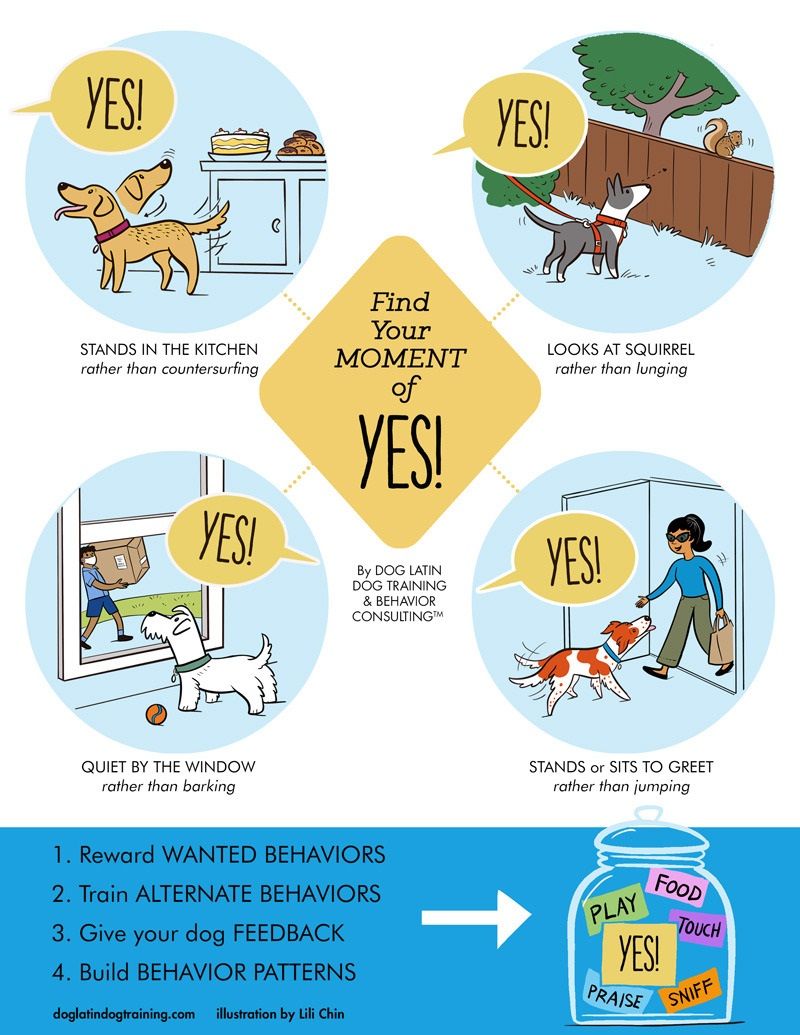
Find your moment of "YES"
Build positive behaviours and relationships rather than trying to train away unwanted ones.
Click below on the illustration by Lili Chin to learn more.
What:
- A marker is a word or sound that informs your dog the moment they have done the right thing, creating a clear link between behaviour and the positive consequence (the reward)
- A marker enhances your communication with your dog, providing them with the feedback they need to learn, perform and improve.
- A well-conditioned marker elicits an emotional response in the dog.
- For maximum impact, a marker needs to have a sharp, consistent sound and be timed precisely.
- CS = Conditioned Stimulus (Something that wouldn't naturally elicit a response), US = Unconditioned stimulus (something that naturally elicits a response)
Why:
- A well-conditioned marker allows you to positively reward your dog the second they do something you like, dramatically improving your training.
- A marker, once established, allows you to train and reward the dog even when you have no treats.
- A marker can be paired with alternate reinforcement for times when your dog may not be food-motivated.
- A marker enables you to raise criteria easily.
- A marker can help eliminate unwanted behaviour and is helpful when working with a reactive dog.
- A marker enables you to use more effective training techniques like capturing and shaping.
- A marker can help prevent frustration in the dog during training.
- A marker helps remove unwanted parts in a behaviour loop.
Types of Markers

A device that produces a sound, usually when pressed.
Benifits
- It's a consistent sound. that can carry over long distances.
- It is clear and precise.
- It can be conditioned and used by different people, making it an excellent tool for multiple individuals working with the same dog.
Limitations
- A clicker requires the user to learn how to use one properly.
- The clicker requires one hand to be free.
- Multiple clickers in a group setting can become confusing and distracting.
.jpeg)
A word like Yes or Good dog
Benifits
- It's easy to use and convenient.
- You can personalise the marker for each dog.
- It can be quicker to use, making it more precise.
Limitations
- It's common for people to keep talking after marking, making it less effective.
- It can be hard to hear from soft-spoken people.
- It can convey emotion, making it sound different at different times.
.jpeg)
A hand signal or even a torchlight.
Benifits
- Helpful for def dogs.
- Can be used in a quiet setting
- Pointing can help single out an individual in a group
Limitations
- Requires the dog to be looking in the direction of the visual cue
- Light-producing devices may not work in direct sunlight.
- The individual's range of vision limits its use
How:
To pair the marker effectively with reinforcement, we use Classical Conditioning.
- For it to be effective, the dog must experience the marker first, followed quickly by a primary reinforcer like food. If the time between the two is too great, then learning will not occur.
- If you show the dog the food first, the sight of food becomes the visual cue or lure for the behaviour, making the marker less effective.
- If you use the marker after giving the dog the reinforcement, it is called backward conditioning, and some studies suggest it can weaken the marker.

Steps for a high-energy Yes/clicker – (Event marker that marks the completion of the behaviour)
- Present the marker "Yes" or click.
- Deliver reinforcement quickly and directly to your dog.
- Repeat around 5 to 10 times.
- While training, first ask for the desired behaviour, then Mark & reinforce when the desired behaviour is complete.
Steps for a Good/hold – (Low energy Continuous marker that marks ongoing good behaviour)
- Say the marker word Good, hold or even a Shush sound in a slow, low-energy, calming tone.
- Reinforce with food or gently pat the dog (if they enjoy it), make these actions slow, lingering and deliberate.
- Repeat the marker and reinforce again if the dog is in the same position.
- While training, when the dog is performing the desired behaviour, Mark & reinforce, then keep repeating the marking/reinforcement cycle as long as the dog holds the behaviour.
Using your marker effectively:
- Once you have built and conditioned the marker, you can use it during training.
- Mark the instant the dog does the right thing. For example, if you ask the dog to sit, the second the dog’s backside touches the floor, you mark "YES" followed by a food reward.
- You can use more than one marker for the same behaviour, for example: When getting a dog to ‘SIT’, mark "YES" and reward when the dog sits. To keep them seated, you can then follow up with "GOOD" and then slowly deliver the next treat or pats.
- Avoid using extra words like good job after the marker.
- It may be more effective if you charge the marker before every training session.
The fastest way to pair or build a marker word is by using food as a primary reinforcer when your dog is hungry. This is because you can deliver the marker followed by food, and a few seconds later, once your dog has swallowed the food, you can go again, making the learning quick and enjoyable for both the human and the dog.
Once the marker is built at dinner time, you can strengthen it by using other reinforcers such as sniffing, toys, play, access to certain areas like the outside or that comfy spot on the couch, pats, praise and even interaction with other people and animals.
For good mechanics when training, deliver the marker first, then present the food. Avoid letting your dog see the food in your hand first or the hand reaching into your treat pouch. This ensures you reward your dog, not bribe them. Here is an excellent guide by McCann Dogs Bribe VS Reward.
For good mechanics when training, deliver the marker first, then present the food. Avoid letting your dog see the food in your hand first or the hand reaching into your treat pouch. This ensures you reward your dog, not bribe them. Here is an excellent guide by McCann Dogs Bribe VS Reward.
Great Videos by other trainers


No reward markers (NRM)
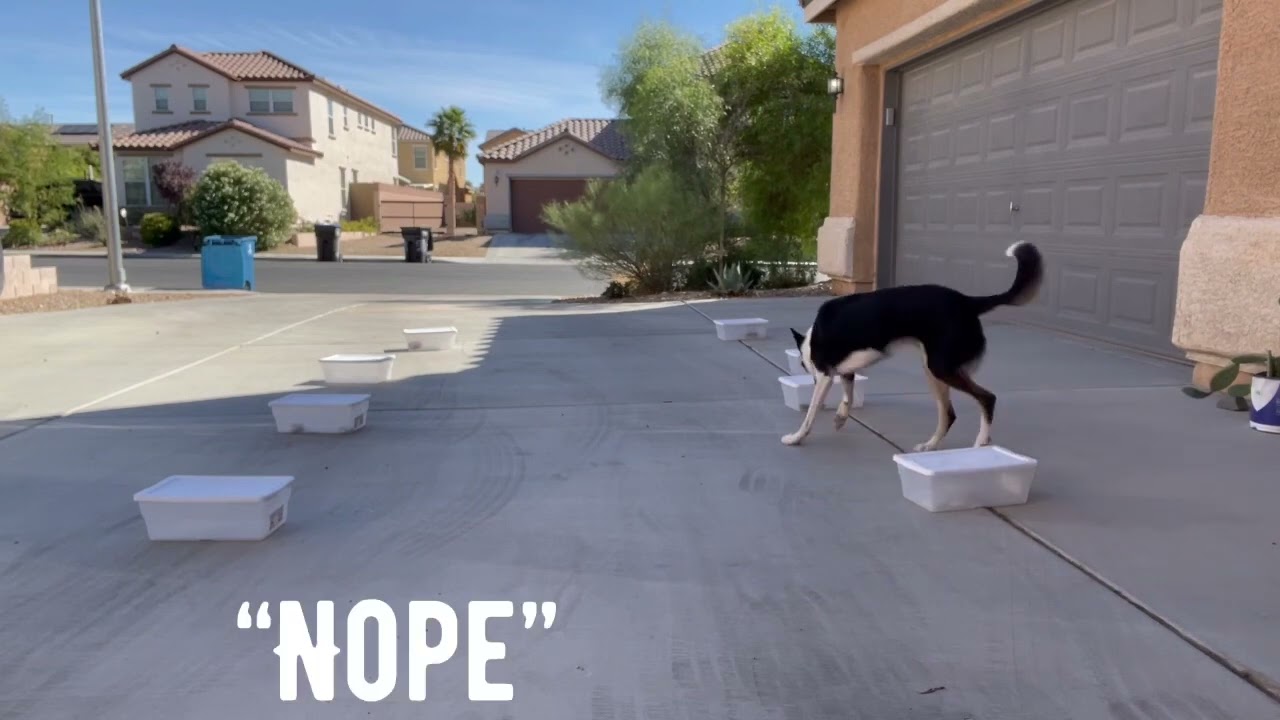
No reward markers serve as a form of feedback, letting your dog know they are not on the right track and need to try again.
When used correctly with the right learner, they can speed up learning and create a better understanding for your dog of what they need to do.
Some trainers who have built a high rate of reinforcement find blank one or two second pauses more effective than an NRM. Such pauses also encourage the dog to problem solve for themselves.
If you ask the dog for a well-known alternative behaviour after using an NRM, giving them a chance to still earn reinforcement, it can help to keep them engaged, which is helpful for dogs who get frustrated easily.
NRM markers should never be used as a punishment and should not have an emotional attachment. If you find yourself getting angry and frustrated, stop using your NRM, and take a break.
If your NRM is not working as intended, reduce criteria and go back to training the behaviour.
Using less aversive words like "Uh Oh," "Whops," or "Nice try" can help humans remember to remove the emotion from this marker.
Before using a no-reward marker, make sure the dog has been trained and understands the behaviour you're asking for and that you are using the right reinforcement when asking for the behaviour.


More resources: